"Perfect. Will be back for more!"
Anna S.
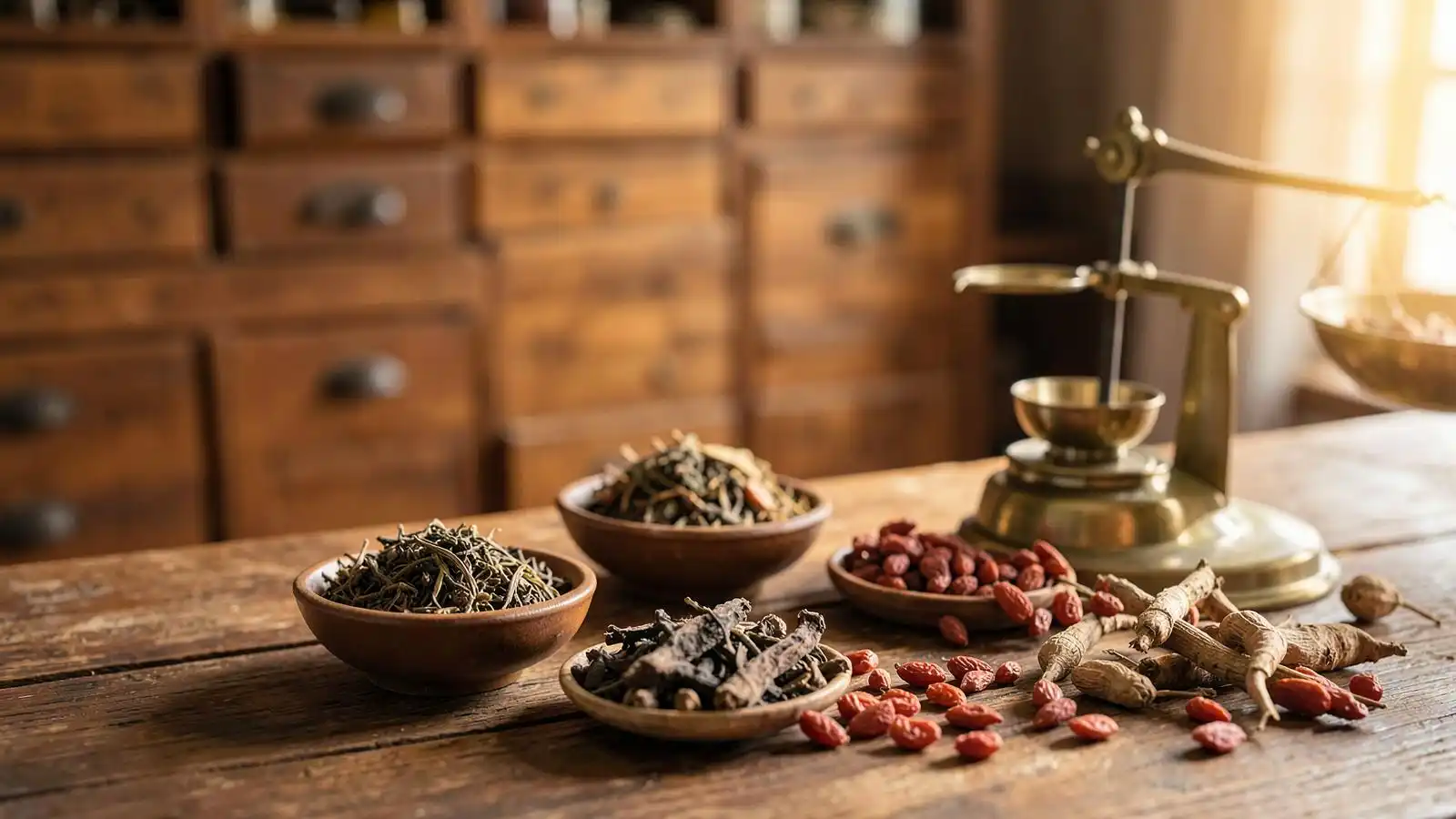
Personalised Chinese herbal medicine in Holborn from registered practitioners, used for digestive complaints, low energy, hormonal issues and skin conditions.
Chinese herbal medicine uses combinations of plant, root and mineral ingredients, prescribed as a formula tailored to you rather than a single remedy for a named condition. It comes from the same tradition as acupuncture and is often used alongside it. At our Holborn clinic, registered herbalists take a full health history and examine your pulse and tongue before writing a prescription, and formulas are reviewed and adjusted as treatment goes on.
Chinese herbal medicine is a system of prescribing combinations of herbs, tailored to an individual's pattern of symptoms rather than to a diagnosis alone. A practitioner takes a detailed history, examines the pulse and tongue, and prescribes a formula, usually as granules, tablets or a decoction to prepare at home. It is commonly used for digestive complaints, low energy, hormonal issues and skin conditions, and is often combined with acupuncture. Formulas are reviewed at follow-up appointments and adjusted as your symptoms change.
Bloating, irregular digestion and IBS type symptoms are among the most common reasons people come, usually alongside dietary advice.
Tonic formulas are used for ongoing tiredness, often where standard investigations have not found a clear cause.
Irregular cycles, period pain and menopausal symptoms are frequently treated with a formula, sometimes alongside acupuncture.
Some skin complaints are approached from the inside as well as topically, with a formula built around the pattern involved.
People prone to frequent colds or respiratory infections sometimes use herbal medicine as part of a longer-term plan to support resilience.
Several of our practitioners combine needling with a herbal formula in the same course of treatment, when that combination suits what you have come with.
A detailed conversation covering your main complaint, digestion, sleep, energy, cycle if relevant, medication and medical history.
Traditional diagnostic methods used to identify the pattern behind your symptoms, which guides the formula.
A formula is chosen and prescribed, usually as granules or tablets, with clear instructions on dose and timing.
Formulas are reviewed at follow-up appointments, usually every few weeks, and adjusted as your symptoms change.
BAcC registered acupuncturist and RCHM registered practitioner of Chinese herbal medicine, with an MSc in Chinese Herbal Medicine and a diploma in Chinese medicine obstetrics and gynaecology. He often combines herbal prescriptions with acupuncture for complex, multi-system problems.
View full profilePractitioner of Traditional Chinese Medicine, including herbal medicine, acupuncture, diet therapy and tuina massage, and a western herbalist who served as a past President of the National Institute of Medical Herbalists.
View full profileChinese herbal medicine works from patterns rather than named conditions, which is why a first appointment covers far more ground than the specific problem you came with. Two people with the same diagnosis in conventional terms can be given quite different formulas if the underlying pattern differs.
Formulas are usually supplied as granules or tablets, which are easier to take and store than raw herbs, though a small number of practitioners still prescribe traditional decoctions. Your practitioner will explain how to take your formula and what changes to look out for.
Herbal formulas can interact with prescribed medication, so a full medication history is taken at the first appointment, and you should mention anything new at follow-ups. Our practitioners will tell you plainly if a formula is not appropriate alongside something you are taking.
Chinese herbal medicine is used as a complement to conventional care, not a replacement for it. Anything that needs urgent medical attention, or symptoms that are new, severe or unexplained, should be seen by your GP.
The evidence base for Chinese herbal medicine is mixed and varies considerably by formula and condition, with some individual herbs and formulas studied more than others. Much of the research has been carried out in China and can be difficult to compare directly with UK clinical practice.
We are honest about this. Herbal medicine is offered as a considered, individually prescribed treatment rather than as one with strong trial evidence across the board, and we would rather you had a clear sense of what is established and what is not.
Herbal medicine is not risk-free. Quality and sourcing of ingredients matter, and some herbs are unsuitable in pregnancy, for certain medical conditions, or alongside particular medications. Our practitioners source from reputable suppliers and will discuss any relevant precautions with you directly.
Chinese herbal medicine is not statutorily regulated in the United Kingdom. The standard to look for is registration with a recognised professional body, and our practitioners hold registration with the Register of Chinese Herbal Medicine (RCHM) or equivalent bodies such as the National Institute of Medical Herbalists.
The first appointment is the longest, usually around an hour, because your practitioner needs a full picture: the presenting problem, digestion, sleep, energy through the day, temperature, appetite, menstrual cycle where relevant, and your medical and medication history. Pulse and tongue are also examined, both of which inform the pattern rather than serving as diagnostic tests in the conventional sense.
A formula is then prescribed for a set period, commonly two to four weeks, after which you return so it can be reviewed. Formulas are expected to change as symptoms change, and a practitioner who never adjusts a prescription is not really practising the tradition. Many people find a course runs over two or three months, with appointments becoming less frequent as things settle.
"Perfect. Will be back for more!"
Anna S.
"Great location in the heart of the city! I would say it's a quiet oasis in a very busy area, a place to relax after a hard day at work."
Robert D.
Sessions are held at 46 Theobalds Road, a few minutes from Holborn station. Get in touch to arrange a time.
Book Appointment