"Perfect. Will be back for more!"
Anna S.
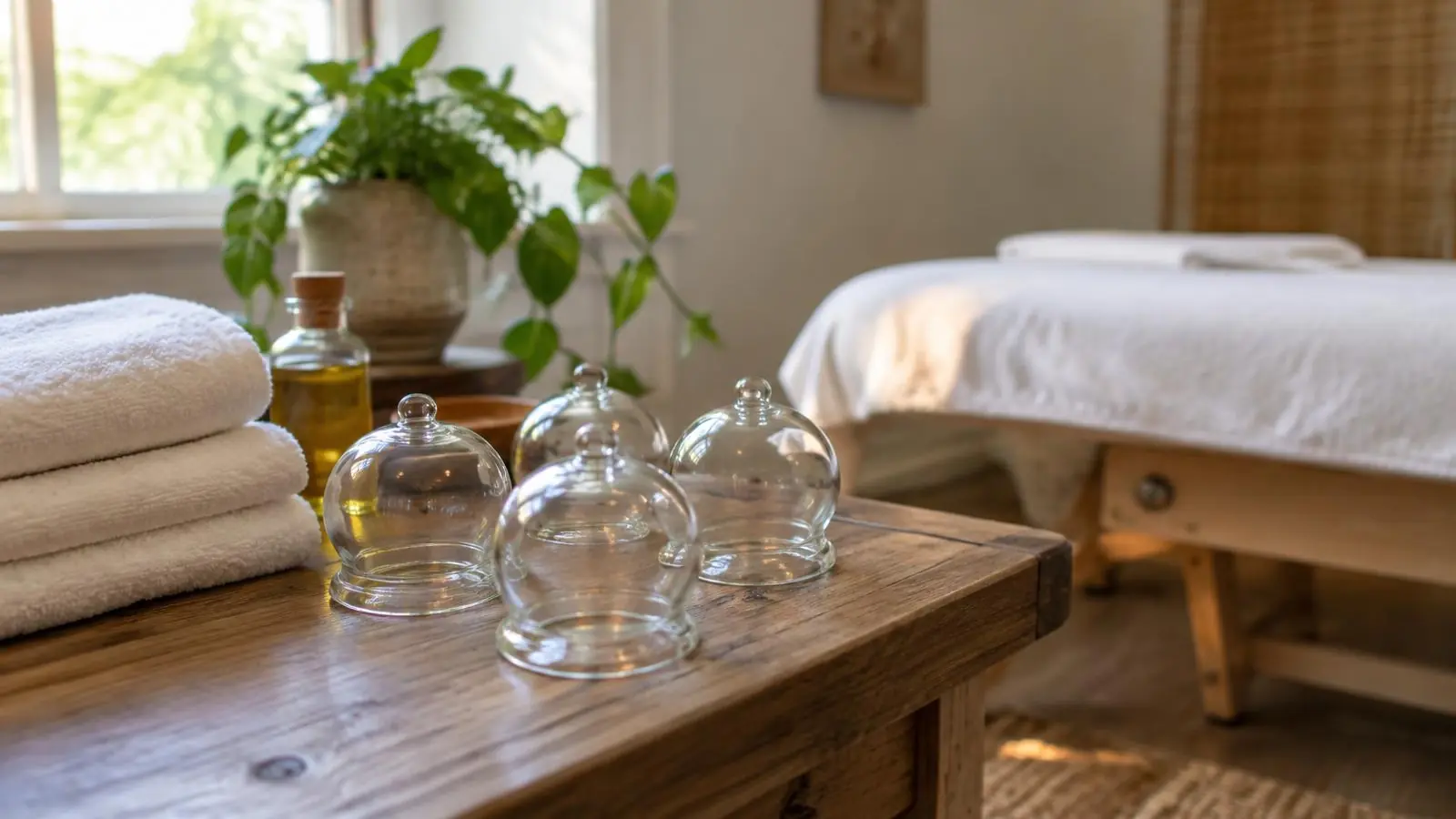
Dry cupping in Holborn for tight, aching backs, shoulders and legs, given within an acupuncture or massage appointment by a registered practitioner.
Cupping uses glass or silicone cups to create suction on the skin, lifting the tissue underneath rather than pressing into it. It comes from traditional Chinese medicine and is used here mainly for tight, aching backs, shoulders and legs. Cups may be left in place for a few minutes or slid along oiled skin.
Cupping is a treatment in which cups are placed on the skin and air is drawn out of them, creating suction that lifts the skin and the soft tissue beneath. It is part of traditional Chinese medicine and is also used in Western sports settings. At our Holborn clinic it is normally included within an acupuncture or massage appointment, applied to tight areas of the back, shoulders, hips or legs, and it commonly leaves round marks that fade within a few days.
A different sensation from massage, which many people find works well on stubborn areas between the shoulder blades.
Often used alongside sports massage during heavy training blocks or after a race, when muscles feel congested rather than injured.
Cups are frequently combined with gentle movement so the area is used again while it is warm.
Most often added within an acupuncture appointment rather than booked entirely on its own, when the practitioner judges it suits the presentation.
Because the pull is outward rather than inward, some people tolerate cupping on a sore area better than deep manual pressure.
You feel the pull straight away and it can be released in seconds, so the strength is easy to adjust to your comfort.
A short history, a look at where you are sore and stiff, and a check for anything that would make cupping unsuitable.
You lie comfortably with the area exposed and oiled if sliding cups are going to be used.
Cups are applied and either held in place or moved slowly across the muscle. Tell your practitioner if the pull feels too strong.
Where it fits, gentle movement or acupuncture follows while the area is warm and more comfortable to work with.
Advice on the circular marks, which are not bruises and usually fade within a few days, and on what to do for the rest of the day.
Acupuncturist who includes cupping within treatment where it suits the presentation, working with pain, stress and general wellbeing.
View full profileDry, or static, cupping means cups are placed and left in position for a few minutes over a tight area. Sliding, or moving, cupping means the skin is oiled first and the cup is drawn slowly along the muscle, which feels closer to a broad massage stroke. Fire cupping describes the traditional method of creating the vacuum with a brief flame inside a glass cup before placing it; the flame never touches you.
Which is used depends on the area, your skin and what you find comfortable. Silicone and pump cups allow very fine control of the suction, which is generally preferred for first appointments and for people who mark easily.
The circular marks are the part that surprises people. They are caused by suction drawing blood towards the surface of the skin, not by impact, and they are usually painless to touch. Colour and duration vary between people and between areas of the same body, and typically fade over three to seven days.
If you have a wedding, a photoshoot, a swimming gala or anything else where visible marks matter, say so at the start of the appointment. Lighter suction, shorter application or a different treatment can be used instead.
Research into cupping is limited and of mixed quality. Reviews of trials in non specific neck and low back pain report short term reductions in reported pain, while noting small study sizes and the difficulty of blinding a treatment that leaves visible marks.
Our position is straightforward. Cupping is offered as supportive care for muscular tightness and discomfort alongside your regular healthcare. We do not present it as a treatment for disease, and we will say plainly when something you describe belongs with your GP first.
The upper back, shoulders and neck account for most cupping done here, usually in people who spend long hours at a desk and arrive with a band of tightness across the shoulders that massage alone has only partly shifted. The lower back is the next most common, often alongside acupuncture for longstanding stiffness.
Cupping is also used on the calves, hamstrings, quadriceps and the side of the hip in people who run, cycle or lift, where the aim is to ease tightness that keeps returning with training load. Smaller cups can be used on the forearms, which suits musicians, hairdressers and anyone whose work is gripping based.
"Perfect. Will be back for more!"
Anna S.
"Great location in the heart of the city! I would say it's a quiet oasis in a very busy area, a place to relax after a hard day at work."
Robert D.
Sessions are held at 46 Theobalds Road, a few minutes from Holborn station. Get in touch to arrange a time.
Book Appointment